FiBL Organic Agriculture Research Institute and IFOAM - International Organic Organization have conducted research and published the report "World of Organic Agriculture" annually. The 25th report published in February 2024 updated the current status of organic agriculture in the world and organic agriculture trends in 2024. Information on the current status of organic agriculture development is summarized as follows:
Countries with organic operations 2022: 188 countries
Organic agricultural land 2022: 96.4 million hectares (2000: 15 million hectares)
Australia (53.0 million hectares) India (4.7 million hectares) Argentina (4.1 million hectares)
Growth of organic farming land area
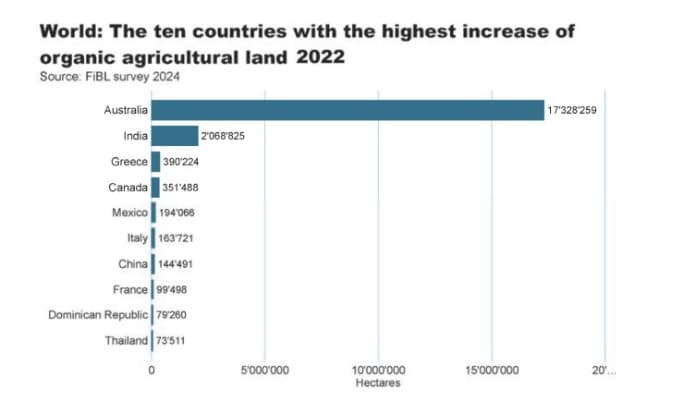
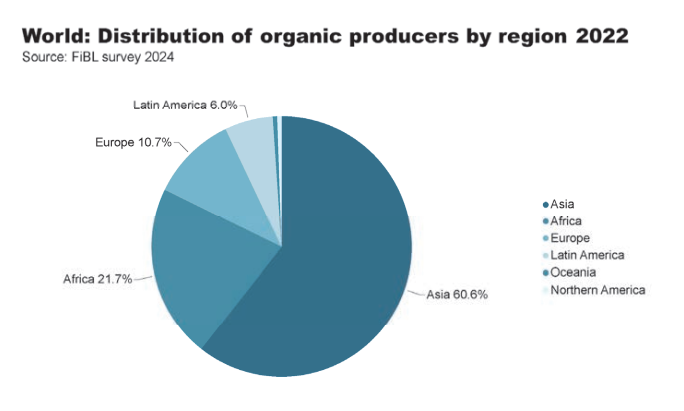
Unprecedented growth in organic agricultural land – 20.3 million hectares increase Organic agricultural land sees a significant expansion of 20.3 million hectares (26.6%) in 2022, with many countries reporting significant growth. The largest increases in absolute terms were observed in Australia, India and Greece.
Organic producers are on the rise
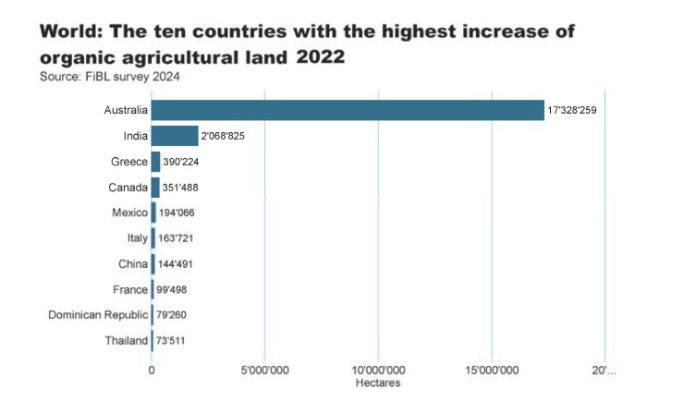
In 2021 the number of global organic producers was 4.5 million, in 2022 the number increased to a staggering 4.5 million. Asia leads with 61% of the world's organic producers, followed by Africa with 22%, Europe with 11% and Latin America with 6%. The top three countries with the highest number of organic producers are India (2'480'859), Uganda (404'246) and Thailand (121'540). Notably, the number of manufacturers has increased significantly, with a strong increase of nearly 919’000, a staggering 25.6% growth compared to 2021.
Exports to the US increased, exports to the EU decreased
In 2022, the EU and US imported a total of nearly 4.9 million tons of organic products, marking a 4.2% increase from around 197,000 tons. While total exports to the EU decreased by 146×173 tons (-5.1%), exports to the US increased by 342×867 tons (+18.8%). Ecuador emerged as the top exporter, followed by Mexico and Peru. Exports grew significantly in Mexico, Togo and China, while imports from India, the UK and Chile decreased significantly. The three most imported organic products are bananas, soybeans and sugar, accounting for 46% of total imports. The United States, the Netherlands and Germany serve as the main importers, accounting for nearly 74% of total organic imports (please note that the volume imported into the United States is incomplete).
Organic agriculture market
The global market reached nearly 135 billion euros. Organic food and beverage sales will reach nearly 135 billion euros1 2, according to FiBL (page 56)3 4 by 2022. In 2022, the countries with the largest organic markets are the United States (58.6 billion euros), Germany (15.3 billion euros) and China (12.4 billion euros). The largest market is the United States (43% of the global market), followed by the European Union (45.1 billion euros, 34%) and China (12.4 billion euros, 9.2%). Switzerland has the highest per capita consumption in 2022, with 437 euros. The highest organic market shares were achieved in Denmark (12.0%), Austria (11.5%) and Switzerland (11.2%). Some markets have experienced declines and in Europe, organic retail sales fell by more than 2%.
Regarding regulations for organic agriculture
According to the latest data collected by IFOAM – Organics International, in 2022, 75 countries have fully implemented organic agriculture regulations. Twenty-one countries have organic regulations that are not yet fully implemented, and 14 countries are drafting laws. Guidance for grower groups under the new EU Organic Regulation 2018/848 introduces significant changes affecting millions of organic farmers globally
Policy on organic farming
A growing number of governments globally are actively supporting agroecological policies, demonstrating their commitment through the introduction of new initiatives and programs with clear, pre-defined goals. Countries such as Tanzania, Vietnam, Cambodia, Japan and Taiwan are notable examples of this trend. At the same time, at the regional scale, there is a marked increase in the adoption of agroecological policies, driven by the development of strategic initiatives. Notable cases include joint efforts by ASEAN countries and proactive measures taken by African Union members.
Source: FiBL & IFOAM – Organics International (2024): The world of organic agriculture. Frick and Bonn
Source: https://agrihitechvietnam. com/thong-ke-thuc-trang-nong-nghiep-huu-co-on-the-world-phan-1